In the future, every brand will be a machine
This article is based on a talk I gave at Munich Creative Business Week 2026.
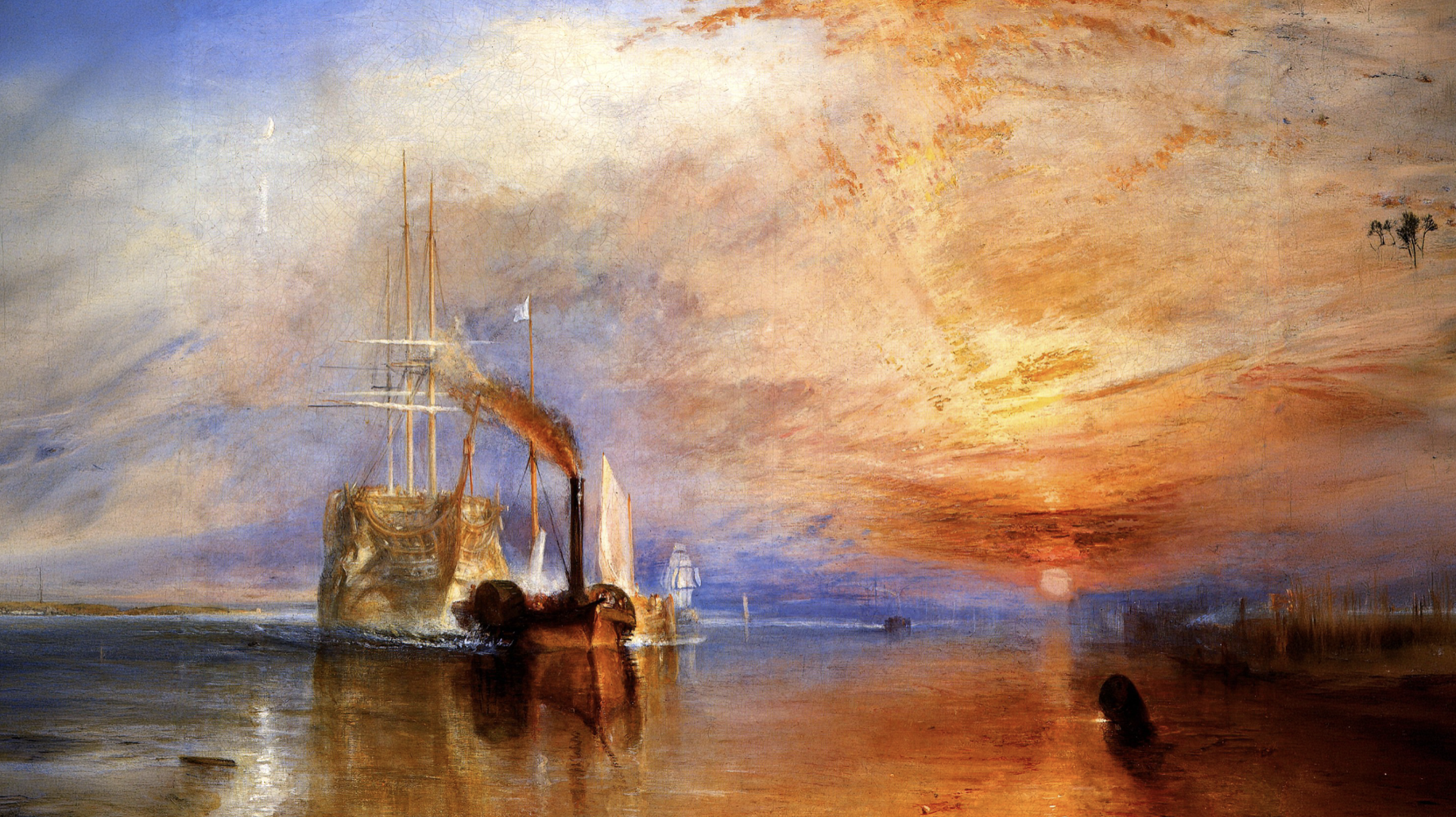
Turner, J. M. W. The Fighting Temeraire tugged to her last berth to be broken up, 1838. 1839. Oil on canvas. National Gallery, London.
J.M.W. Turner’s The Fighting Temeraire depicts a wooden sailing ship of the line being towed to the breaker’s yard by a steam-powered tug. What the painting captures is not just a ship, but a transition in operating logic: an old form being overtaken by a new technological system.
Brands are now entering a similar transition as they are no longer built only for people, but for agents too.
There is a famous quote, usually attributed to Jeff Bezos: “Your brand is what people say about you when you’re not in the room.”
I think this needs an update for 2026: “Your brand is what the robots say about you when you are not in the room.”
Humans are not the only audience for brands anymore.

Diagram after El Lissitzky Beat the Whites with the Red Wedge 1919–20
Brands now exist in systems with new rules. The SEO rulebook has been torn up. Brand messaging is being swallowed by AI-generated content. Brands are turning into API calls, and disappearing from LLM-mediated discovery.
Last year, in its Best Global Brands report, Interbrand said that “the most successful companies will create a seamless balance between designing engagement for agents (bots) and for sentients (beings).”
This means that if the 20th century was about building brands as controlled identities broadcast from the top, then the 21st century is about choreographing brands as actors inside complex, always-on systems.
At Celonis, along with students from the Technische Universität München and the Hochschule München we have been exploring what one of those actors could look like.
Wil-Bot is a prototype digital version of Professor Wil van der Aalst, our Chief Scientist, widely known as the godfather of process mining.
At Celonis, one of our core challenges is education: helping people understand what Process Intelligence is, and why it matters. One of the ways we meet this challenge is creating content with Wil, but of course there’s only so many recordings we can make of him, and only so many users will take the time to watch all of them.
To that end, last year we began a project to make a digital copy of the Professor, which became an experiment in making expert knowledge machine-legible, trustworthy, and scalable.
We built a controlled knowledge base from his academic work, lectures, and approved Celonis materials. Then we built the architecture.
Wil-Bot takes a user question through a chat UI or video avatar, detects language, persona, and industry context, retrieves from the right knowledge tiers, applies the base constitution and persona prompt, runs the answer through the LLM, then validates it for confidence and provenance before returning a sourced answer.
What really differentiates this is the bot constitution, which defines what Wil-Bot is allowed to say and how it behaves.
It acts as a trust layer, forcing the system to use verified sources. It also acts as a safety guardrail: making it cite, refuse, and say “I don’t know” when needed.
Now that this fundamental architecture is built, we can scale Wil-Bot to create a platform of virtual experts based on key Celonis evangelists, forked from one central knowledge lake, always on for sentients and agents.
What this project made clear for us is that if brands are going to operate in a world shaped by agents, they need more than identity, assets, and messaging.
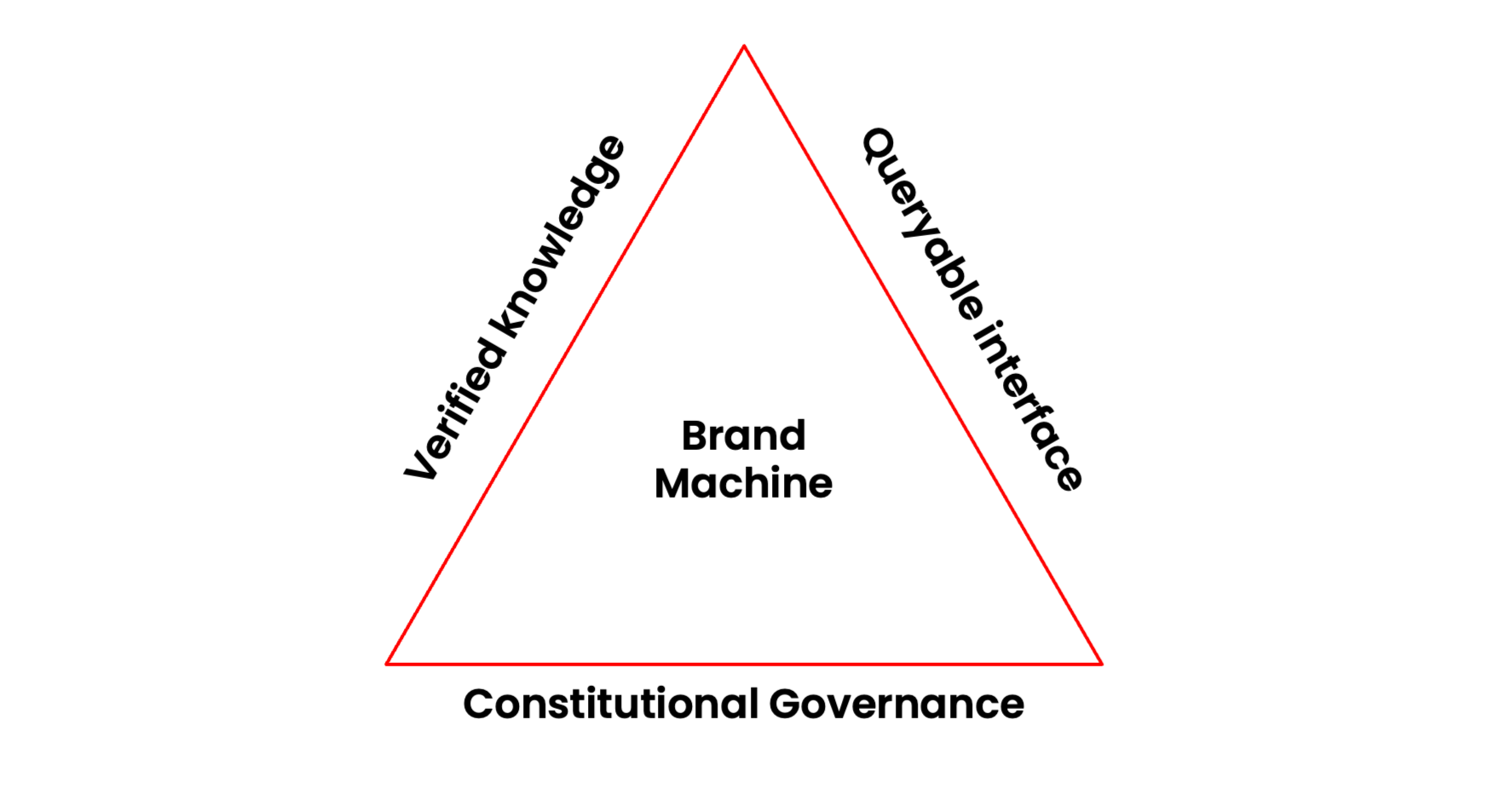
Model for a brand machine. Joseph Steele. 2026.
They need to become machine-legible systems comprised of three things:
They need a source of verified knowledge machines can retrieve from: a corpus of claims, evidence, and memory. If brands don’t provide this in a structured way, agents will make it up.
They need a queryable interface that lets humans and agents interact with the brand directly.
They need a constitutional layer that governs what can and cannot be said.
Wil-Bot is our attempt to build exactly that: a bounded brand actor built on verified knowledge, governed by a constitution, and made available through a queryable interface. Put together, these three things form what I’d call a brand machine. Not a campaign. Not a chatbot. Not just an avatar. A governed system that can operate across human and machine environments.
When technology takes a leap, it also takes a plunge
The internet began life in the 1960s as a packet-switching network for the US Department of Defense, and now we use the same fundamental technology to watch Labubu dolls get haircuts. Few in the 1960’s could have forseen this because when rapid technological shifts are compounding, it is very hard to tell where we might land.
In the age of generative search and agent-mediated spaces, brands have to stop thinking only like advertisers or creatives, and start thinking like system designers and orchestrators.
Because in the future, brands will either make AI happen for them, or AI will happen to them.