The only thing we have to scale, is scale itself
In this article I dive into a concept I’ve been thinking about lately.
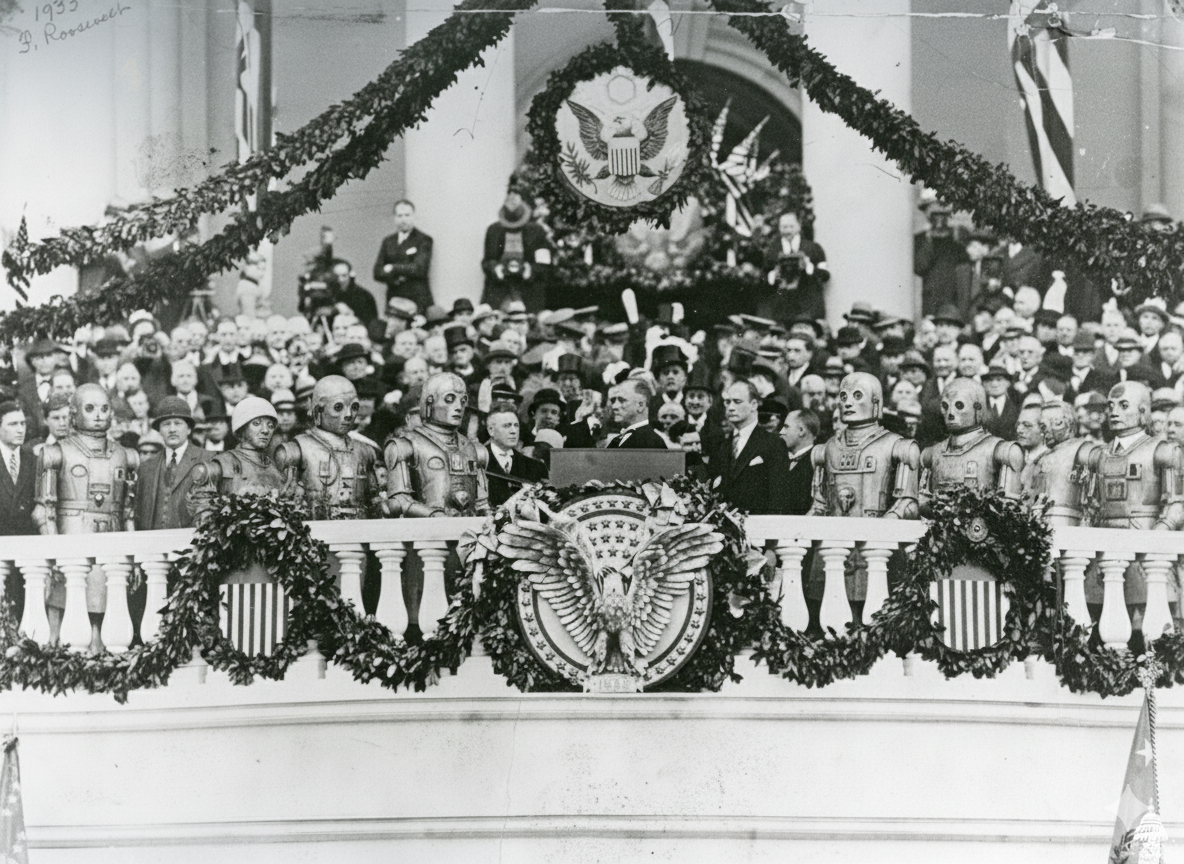
“Franklin D. Roosevelt’s First Inauguration, Washington, D.C., March 4, 1933.” Photograph. National Archives and Records Administration, College Park, MD. Accessed October 13, 2025. https://www.archives.gov/. (Edited by the author)
‘We do X at scale.’
‘Governance at scale.’
‘Deployment at scale.’
In my line of work, I hear these phrases on an almost hourly basis. What I’ve come to conclude that in the age of AI, scale itself is scaling. Everything is getting bigger, faster. Everything is getting more and will only get more more.
I was running some basic financial modelling on some companies recently. I thought it would be interesting to compare market cap with number of employees. Company A had a market cap of over $200bn, and over 100,000 employees. Company B had a market cap of over $400bn and under 4,000. It made me think that in the age of AI, growth is no longer about headcount or stacking tools or opening offices around the world.
It struck me that Company A - in the age of AI - seems suddenly structurally vulnerable. Even if Company B is ‘overperforming’, it is doing so at a lot less risk than Company A. What Company B has done is scale itself far beyond what was previously thought possible without a massive workforce.
There was a time when having a large workforce was a point of pride.
The early modern enterprises (think Sage Software, Oracle, Adobe, Salesforce) have become an immovable hive of interdependent systems and processes constantly feeding (and feeding off of) each other. They were built to function in a certain way - categorise and organise data for humans to interpret and action. They have become plumbing for data. Now, we have decades of fundamental laws of data plumbing firmly established. Think ITIL, RDBMS, ETL Frameworks, Enterprise Data Warehousing or Master Data Management.
Plumbing for data is not what is interesting anymore. We can build data plumbing systems in a heartbeat.
So the modern enterprise - I don’t think we should even call it that - can move on from that. It’s not interesting to create tools to manage massive amounts of human input. What is interesting now is how an enterprise can scale beyond that. The real challenge is what organisations can now do to make that data coherent and composable.
AI accelerates everything - decision-making, production, communication - but acceleration without structure leads to noise. Strategy must evolve from controlling outputs to designing conditions: modular architectures, transparent data, and adaptive governance that allow intelligence to expand without eroding trust. To scale successfully is no longer to grow - it’s to stay intelligible while growing.
The next advantage belongs to those who can scale understanding as fast as they scale execution. Brands, systems, and teams that translate complexity into clarity will define the post-automation era. The future enterprise won’t compete on speed or size, but on its capacity to remain whole as it multiplies. Because the only thing left to scale, now, is scale itself.