Beyond, a publication from Celonis Labs (4th Edition)
In this article I share my summary of this year’s ‘Beyond’ Journal from Celonis labs, focusing on what it suggests about the future of enterprise technology.
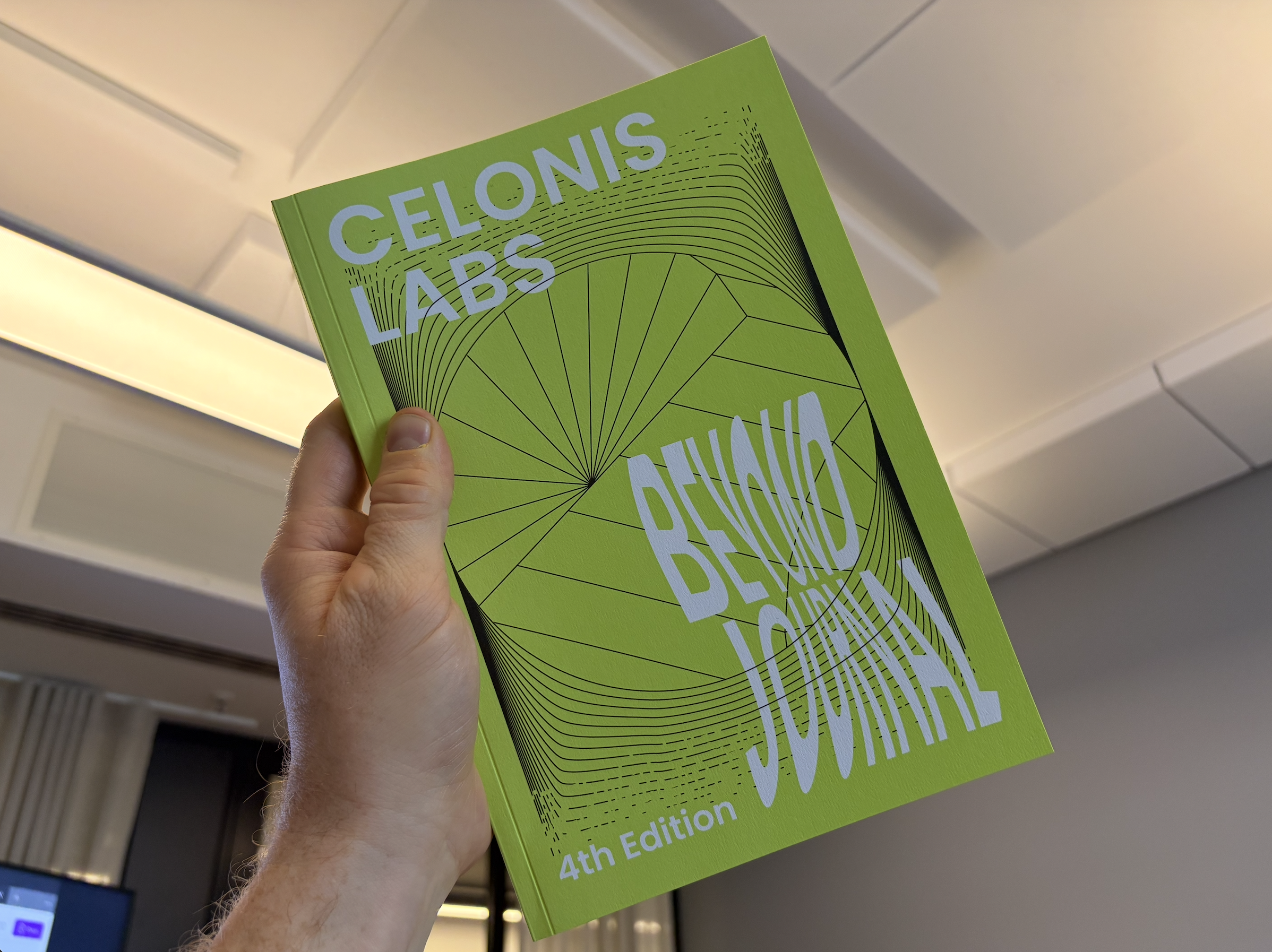
Beyond, a publication from Celonis Labs
The Beyond Journal is Celonis Labs’ annual research publication. It brings together internal research, academic collaboration via the Academic Alliance, and external expert voices to explore how enterprise technology is actually changing beneath the surface.
The 4th Edition looks at why so many enterprise AI and transformation efforts stall - even when the technology is “right”? It’s made up of contributions from Celonis Labs (including Eugenio Cassiano, Bill Detwiler, Kerry Brown, Dr. Monika Gupta, Sowmya Kubendran, Markus Demirci, Judith Dada, and more), the Celonis Garage, partners like Trullion and Atomicwork, and the Academic Alliance.
In the future…
Processes will become the primary truth layer
Not data. Not apps. Not AI. The journal repeatedly returns to the same failure mode: enterprises attempt AI without understanding how work actually happens. Process Intelligence (the core service provided by Celonis) is positioned as the ground truth of operations, the layer that reconciles human narratives (“this is how it works”) with system reality. Kerry Brown’s piece (“Seeing is Believing”) nails this: without a shared, vendor-agnostic view via a living digital twin, debates over “whose version of the truth” derail transformations.
The implied stack flips the traditional model:
From: Dashboards → insights → hope
To: Process truth → context → action
The subtext is clear: AI without process grounding is not intelligence, it’s hallucination at scale.
Digital twins will stop being models and become operating systems
“Digital twin of operations” is no longer framed as a simulation or visualisation. Instead, it’s described as a live decision surface - continuously updated, auditable, causal, and shared across humans and agents. Contributors like Alexander Hill (inside Celonis AI Labs) and the Garage team emphasize this shift to continuous sensing over periodic planning. Strategy stops being a document and becomes executable infrastructure, powered by the Process Intelligence Graph.
Enterprise AI will be agentic-focused, not stuck in chatbot assistants
We should be increasingly skeptical of “assistive AI” narratives. (Stories that frame AI as primarily an assistant to humans rather than an operational actor inside the enterprise.) The future described sees goal-driven agents operating inside workflows, with guardrails, human-in-the-loop thresholds, audit trails, and measurable return on AI. Markus Demirci’s article on the hybrid workforce and “allies” makes this explicit: agents need process context to be useful. Without it, autonomous agents pose real operational risk. Judith Dada echoes this in her piece on acceleration, agency, and abundance: vertical, domain-specific AI outperforms horizontal.
Vendor lock-in will no longer be structurally tenable
There is a cultural and technological shift underway, from closed ecosystems to open ones. Enterprises are irreducibly heterogeneous. Many systems, data models, and tools that cannot be simplified away. Section 1 (“Innovation Requires an Open Ecosystem”) hammers this: truth cannot live inside a single vendor stack. Partners like Trullion (Lease Accounting) and Atomicwork (employee experience) show how open, composable approaches win. ERP and core platforms become infrastructure-necessary, but no longer authoritative. (More like plumbing.)
Decision latency will replace efficiency as the core metric
The new enemy is not waste, it’s delay. The new competitive advantage shifts toward organizations that minimize time from signal → decision → action, even at the expense of perfect plans. In permanent volatility (as discussed in supply chain topics like Alen Arslanagic’s on S&OP moving to agentic execution), monthly planning cycles become redundant.
Humans won’t disappear—but their roles will change
Humans are no longer executors, data retrievers, or process glue. Instead, they become:
Judgment layers
Exception handlers
Goal setters
Ethical governors
Markus Demirci’s contribution on the future of the hybrid workforce captures this structural shift: organizations will soon track AI agents the way they track employees.
Enterprise power will shift from software to epistemology
The deepest claim in the journal is philosophical. The future advantage isn’t features, models, or compute. It’s who defines truth inside the organization:
What counts as reality
What triggers action
What is allowed to decide autonomously
Enterprise tech is becoming an epistemic system, not an IT stack, grounded in Process Intelligence as the shared source of operational truth.
Some further predictions:
Here are blunt summaries of the predictions made across the journal.
Most enterprise AI investments will fail without process grounding
Digital twins of operations will become mandatory infrastructure
AI Assistants will give way to agents within 2–3 years
Static planning cycles will collapse under volatility
Legacy software vendors will lose epistemic authority
Decision latency becomes the primary performance metric
Human roles are redefined, not eliminated
Vertical, domain-specific AI outperforms horizontal AI
Enterprises increasingly compete on truth definition, causality, and authority to act
Final thoughts:
I found this edition of the Beyond Journal very interesting. It names the structural shifts most organizations are already feeling but struggling to articulate. In a space full of immediate noise about the latest AI models, it’s refreshing to read something that isn’t about “what’s next quarter,” but instead asks “what does the future of work actually look like?”
Thank you to the Celonis Labs team (Eugenio Cassiano, Bill Detwiler, and the Garage’s Dr. Monika Gupta and Sowmya Kubendran), the Academic Alliance, partners like Trullion and Atomicwork, and all external contributors (including Judith Dada, Markus Demirci, Kerry Brown, and more) for putting this together.