I See Systems: An Introduction to Systems Thinking
In this article I dive into what we mean when we say ‘systems thinking’ and why I’m thinking about it a lot at the moment.
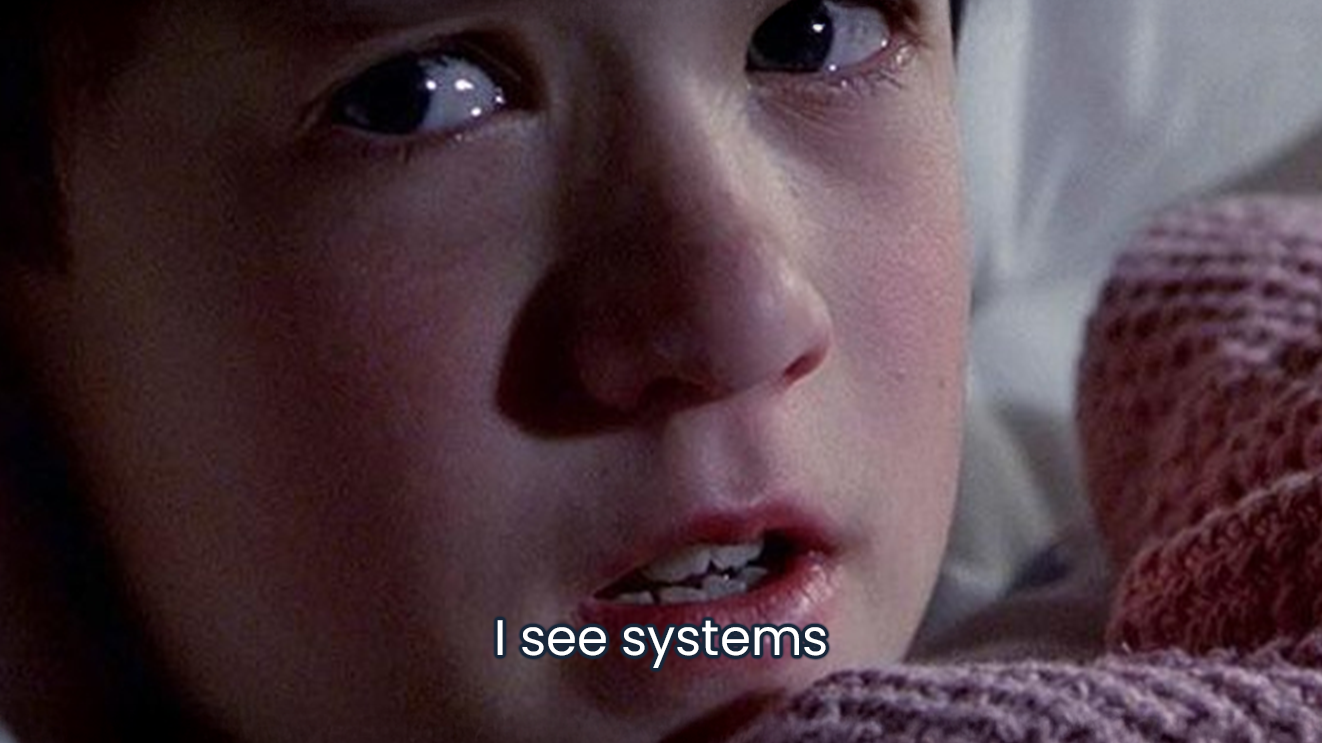
Still from The Sixth Sense, directed by M. Night Shyamalan, 1999. Modified by the author.
To see systems is to notice relationships over time rather than snapshots in isolation. It means observing how outcomes emerge from interconnected parts rather than individual actions alone. Systems thinking does not replace personal responsibility or creativity; it provides context for them. It asks not only what happened, but what conditions made this outcome likely.
In my day-to-day work I am constantly reminded that no output exists independently. Every piece of communication is shaped by upstream decisions about governance, data, incentives, and culture.
Recently, with the help of some very talented students at the Technische Universität München and the Hochschule München, I have been exploring developing an AI-driven knowledge system to act as a digital expert for process intelligence and academic research. The challenge was never just a digital experience or technical accuracy, it was governance. How do we prioritise knowledge? How often is it updated? Who (or what) decides what counts as truth inside the system? These decisions shape how employees think, decide, and communicate. The output of the system is not just information, it is behaviour.
Peter Senge, in The Fifth Discipline, describes systems thinking as the discipline that integrates all others, allowing organizations to move beyond reactive problem-solving toward learning and adaptation. His concept of the “learning organization” suggests that the ability to perceive interconnections is not optional; it is foundational for survival in complex environments.
What It Means to See Systems
Seeing systems involves three perceptual shifts.
First, from events to patterns. Early in my career I often focused on isolated outcomes. A campaign underperformed. A project stalled. A message failed to land. Donella Meadows, in Thinking in Systems: A Primer, emphasizes that events are the least informative level of understanding; patterns over time reveal far more about system behaviour. Once I began looking for recurring dynamics, different insights emerged.

Donella Meadows (1941 - 2001)
American environmental scientist and author
Pictured here at Dartmouth College, 1972
“The behaviour of a system cannot be known just by knowing the elements of which the system is made.”
Second, from parts to relationships. In brand strategy, no function works alone. Marketing shapes expectations that sales must manage. Sales pressures influence product development. Product limitations affect customer success. Senge argues that organizational challenges rarely result from isolated failures but from interactions across departments. Each team becomes both cause and effect.
I see this clearly in brand work at Celonis. Messaging decisions do not live in marketing alone. When positioning shifts toward AI leadership, it affects how sales teams frame conversations, how product teams prioritize roadmaps, and how customer success teams manage expectations. A narrative decision upstream creates operational consequences downstream. Brand, in this sense, is not expression. It is infrastructure.
Third, from blame to structure. Meadows writes that system behaviour is often a product of its design rather than individual intent. This has been one of the most important lessons in my professional life. When tensions arise, it is tempting to focus on personalities. But again and again, I have seen how incentives, unclear governance, or competing priorities shape outcomes more powerfully than individual decisions.
In large-scale brand initiatives, moments of friction often appear interpersonal on the surface. Yet when examined closely, they almost always trace back to structural ambiguity. Unclear ownership creates duplication. Competing KPIs produce misalignment. When governance improves, tensions that once seemed personal often dissolve without confrontation. The system was speaking through people, not the other way around.
A practical expression of this mindset appears in the Japanese practice of the “Five Whys,” often associated with Toyota’s production system. The idea is disarmingly simple: when a problem occurs, ask why. Then ask why again to the answer you receive. Repeat the process until you reach the underlying structural cause rather than the surface symptom. I sometimes joke that while Simon Sinek encourages us to “Start With Why,” I like to joke that we should start with “why, why, why, why, why.” The reason being that systems rarely fail for the reasons we first assume. The discipline of asking why repeatedly trains us to move past the obvious explanation and toward the deeper architecture shaping outcomes.
Systems in Everyday Organizational Life
Organizations are networks of interdependence, yet they are often managed as if departments function independently. This disconnect produces familiar patterns.
I have worked inside environments where quarterly pressure led to rushed decisions. Sales teams moved quickly to meet targets. Delivery teams inherited work that required re-scoping. Support teams absorbed friction. Morale fluctuated. Leadership responded with new initiatives, often addressing symptoms rather than root causes.
Senge calls this tendency “fixes that fail,” where short-term interventions create long-term complications. Meadows similarly describes how well-intentioned solutions can generate unintended consequences due to delayed feedback or overlooked relationships.
Seeing systems reveals how each action reverberates beyond its immediate context. The issue is rarely a single decision. It is the cumulative effect of aligned or misaligned incentives over time.
Feedback Loops and Delays
A key feature of systems is the presence of feedback loops. Meadows distinguishes between reinforcing loops, which amplify change, and balancing loops, which stabilize systems.
I have seen reinforcing loops in team environments where trust generates openness, openness encourages collaboration, collaboration produces success, and success strengthens trust. Conversely, misalignment can create downward spirals.
I have also seen how recognition loops influence creative output. When teams feel their contributions are visible and valued, they experiment more freely. Innovation increases, which leads to stronger outcomes, which further reinforces trust. The inverse is equally true. Systems amplify emotional climates just as reliably as they amplify operational processes.
Delays complicate perception. Meadows stresses that the time between action and consequence often leads decision-makers to misinterpret cause and effect. In creative and strategic work, this is especially visible. A messaging shift may initially create confusion before producing clarity. Without systems awareness, organizations may abandon effective changes prematurely.
Why Systems Thinking Matters to Everyone
Traditionally, systems thinking has been associated with leadership roles. However, Senge emphasizes that learning organizations depend on participation at all levels.
For individuals, systems awareness improves decision-making and reduces frustration. When you understand why certain problems persist, they become less personal and more navigable.
For teams, systems thinking fosters empathy. Recognizing interdependencies reduces siloed behavior and encourages collaboration.
For organizations, it enhances adaptability. Meadows argues that the most resilient systems are those capable of learning and self-correction. This capacity depends on widespread awareness rather than centralized control.
Systems and Information Flow
Modern organizations operate within dense information ecosystems. Data moves rapidly, but interpretation often lags. My work with AI systems has made this especially visible. Technology can accelerate access to knowledge, but it cannot replace thoughtful interpretation.
Working with AI knowledge systems at Celonis has made this especially visible. When information flows cleanly across teams, decision-making accelerates and confidence increases. But when knowledge is fragmented or inconsistently maintained, people default to intuition or hierarchy. The issue is rarely intelligence. It is accessibility. Meadows identifies this as a leverage point because changing who sees what, and when, can reshape the entire system without altering personnel or strategy.
Seeing systems involves noticing how information moves, who has access to it, and how it shapes behaviour.
The Human Dimension
It is important to clarify that systems thinking does not reduce people to mechanical components. My background in poetry continually reminds me that meaning is emotional as much as structural.
Senge highlights the role of shared vision and mental models in shaping system behaviour. Culture, narratives, and emotional climates influence how systems function. Ignoring these dimensions leads to incomplete understanding.
Seeing systems means acknowledging both measurable structures and intangible dynamics.
Conclusion
To say “I see systems” is to describe a way of perceiving complexity. It is an acknowledgment that outcomes are rarely accidental and that understanding relationships over time offers greater clarity than focusing on isolated events.
From childhood visits to war memorials to my present work in brand strategy and AI systems, I have learned that the structures shaping outcomes are often invisible until we train ourselves to look for them.
Working inside a company focused on process intelligence has only sharpened this perception. Celonis itself exists to help organizations see their operational systems more clearly. In many ways, my professional environment continually mirrors the lesson Meadows and Senge describe: once visibility improves, behaviour changes. Systems do not need force as much as they need illumination.
Senge writes that the fifth discipline is the ability to see wholes rather than parts. Meadows reminds us that systems thinking is not about control but about understanding.
In contemporary organizations, where change is constant and interdependencies are dense, this perspective is no longer optional. Systems thinking supports better decisions, stronger collaboration, and more sustainable growth.
Seeing systems does not eliminate uncertainty. It provides a framework for navigating it. Once you begin to notice patterns, feedback loops, and structural influences, they become difficult to ignore.
Like a quiet perceptual shift, the world remains the same, but clarity increases. And with that clarity comes the possibility of acting with greater awareness of the structures shaping outcomes, not just the outcomes themselves.
References
Meadows, Donella H. Thinking in Systems: A Primer. Chelsea Green Publishing, 2008.
Senge, Peter M. The Fifth Discipline: The Art and Practice of the Learning Organization. Doubleday, 1990.