Field notes: Digital Cosmos Amsterdam, November 2025
In this article I share my notes on a conference I attended in Amsterdam.
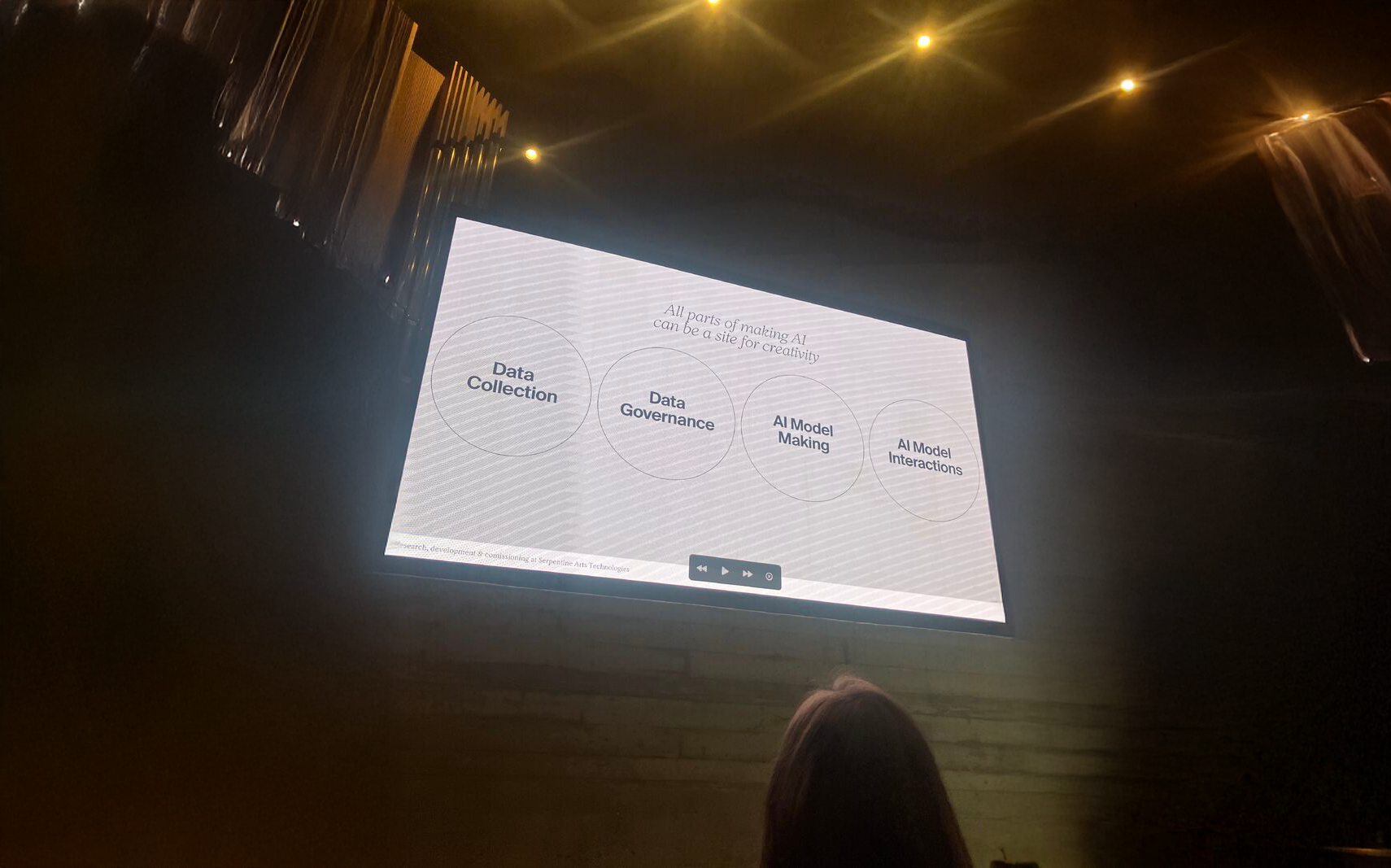
Screenshot from Benjamin Bratton’s presentation
Last November I had the opportunity to attend Digital Cosmos with Kris Dittel. It was a two-day international forum hosted at De Thomas / Thomaskerk in Amsterdam that explored the convergences of artificial intelligence, life, and art - and what it means to navigate our rapidly changing digital reality.
The programme brought together visionary artists, thinkers, and technologists, and I left inspired by the depth, diversity, and urgency of the questions raised.
Key Voices & Moments
Keynote speakers and contributors included Holly Herndon, whose work sits at the intersection of music and AI; Yuk Hui, speaking on technology, cosmotechnics, and the future of thought; Marina Otero, bridging design, institutions, and systems; John Gerrard, exploring simulation, ecology, and planetary computation; and Benjamin Bratton, known for his work on The Stack and planetary-scale infrastructures. The programme was further enriched by dynamic contributions from Cory Arcangel, Nolan Oswald Dennis, and voices including Xin Liu, Lukas Likavčan, Bahar Noorizadeh, Metahaven, Nestor Siré, and many others.
Across keynotes, conversations, and panels, the programme grappled with what happens when intelligence and technology become indistinguishable from life, how art can meaningfully engage with social, ethical, ecological, and planetary-scale change, and which digital and cultural infrastructures will matter most in shaping our collective futures.
Personal Takeaways
What I took from Digital Cosmos is not a list of insights but a feeling of ontological destabilisation: that AI isn’t simply changing tools or workflows, but bending aesthetics, language, capitalism, and even the concept of “humanity” itself. Acceleration is not a policy choice but a structural condition - capitalism as a one-pedal system - and AI intensifies it beyond our capacity to govern, resist, or even name what we’re resisting yet. The question is no longer how humans use technology, but whether “the human” is still the right unit of analysis at all, as Earth, computation, climate, extraction, and intelligence collapse into a single technical system.
Across art, ecology, warfare, cloud infrastructures, and planetary science, the same pattern repeats: technologies carry assumptions, power systems require resistance, but the terrain is shifting faster than language can stabilise. We are not alone on the planet anymore - AI occupies it with us - and the danger is not a dramatic machine uprising, but a quieter moment when intelligence ceases to need us as a meaningful node. Art, in this context, is no longer decoration or critique but a site of scale-matching: if we can destroy at planetary scale, we must learn how to create, think, and mourn at that scale too.