All’s Fair in Tech and War: The Dawn of the Robot Layer
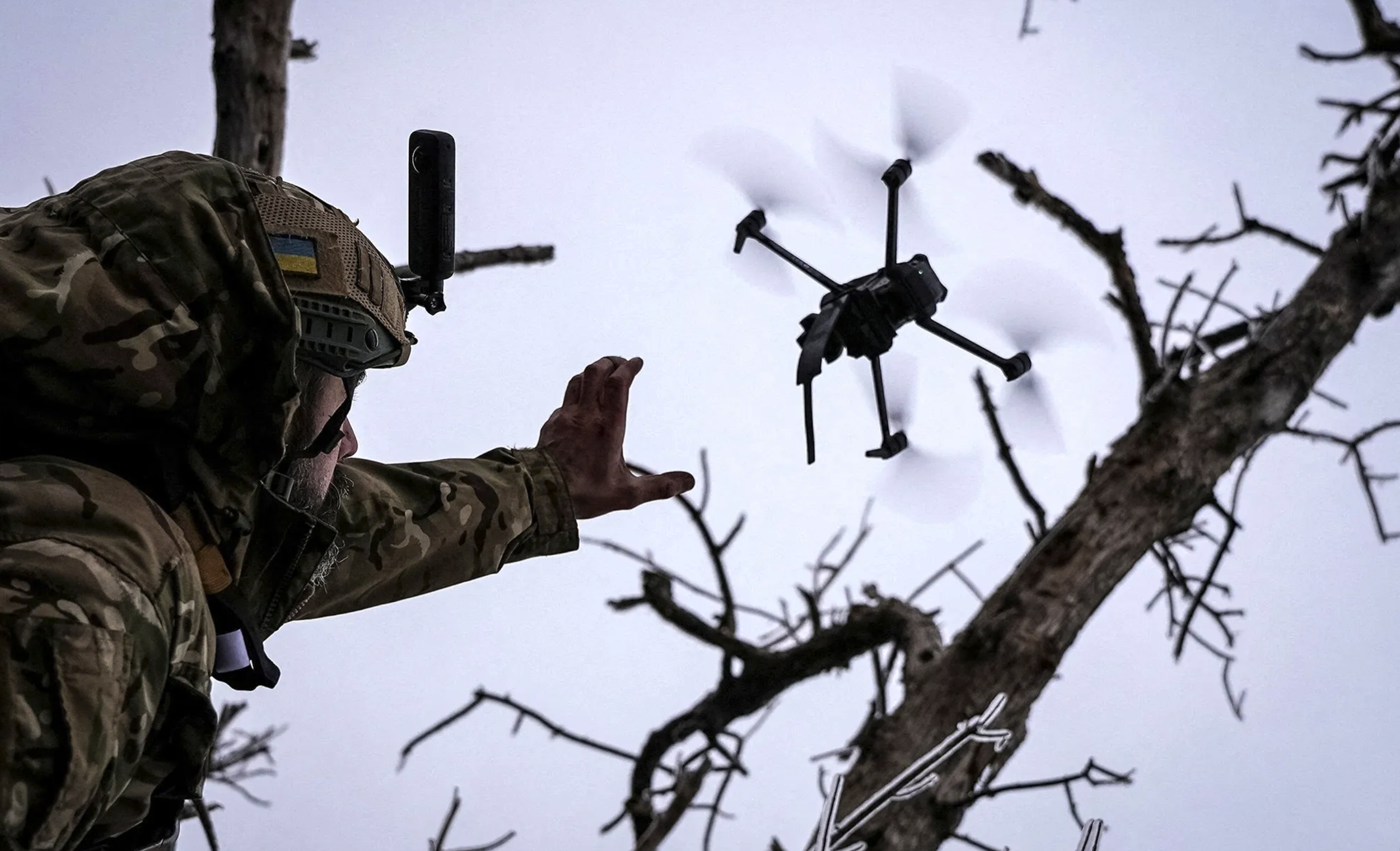
Ukrainian soldier, 128th Separate Mountain Assault Brigade, deploys FPV kamikaze drone against Russian positions near Kyiv, March 2022. Photograph by Kostiantyn Liberov.
One of my life-long interests is the evolution of military hardware. This began at a young age when I would bunk off school to read my dad’s history books, and through the annual family ritual of visiting war graves and museums in France and Belgium at the end of the summer holidays.
In the last four years we have seen how decades of established military doctrine have been ripped apart as the battlespace has changed with the the mass deployment of robotics and AI battle management systems. We have seen how drones have been used to take out tank columns, send soldiers underground, and force vehicles to adopt emergency protections from “cope cages” to “dread armour.” This “Robot War” has led to the emergence of what I call the “Robot Layer.”
In my opinion, there is something similar happening in the field of communications, especially when we talk about how brands communicate in the age of AI. Brands are beginning to bend toward AI-powered comms methods and sales methods. We are now in a world where “the robots” mediate between brands, augmenting human mediation. This mediation will only expand as brands evolve communication and sales methods to the point where a robot layer will exist around each and every one.
Why am I thinking about this? Well, in my spare time I read a lot about military hardware and the evolution of warfare, and in my work life I spend my time trying to understand how brands communicate. With all of this in mind, in this blog I will attempt to explore what the Robot Layer means in contemporary warfare and commerce.
Introduction
In an era defined by rapid technological advancement, human interactions - whether in conflict or consumption - are increasingly mediated by automated systems. This mediation constitutes what can be termed the “Robot Layer": a stratum of algorithms, drones, and artificial intelligence (AI) that filters, processes, and influences access to information, resources, and audiences. This concept extends beyond metaphor to describe tangible infrastructures that shape outcomes in both military and commercial domains. Drawing on evidence from recent conflicts and market analyses, this article examines the robot layer's manifestations, parallels between warfare and marketing, and strategic implications for entities operating within these spaces.
The Robot Layer in Modern Warfare
Contemporary battlefields exemplify the robot layer through the pervasive integration of unmanned aerial vehicles (UAVs), or drones, which extend human capabilities while inserting new strata of mediation. In the ongoing Ukraine-Russia conflict, drones have become indispensable, with Ukraine producing up to four million units annually by 2025. This mass deployment has transformed the physical artefacts of war: roads now shimmer with fishing nets, vehicles hide beneath improvised chicken wire. The result is a landscape of area denial - but also a new interfacing zone where robots battle robots long before human combatants ever engage.
The first U.S. drone strike outside a conventional battlefield took place on 3 November 2002, when a CIA-operated MQ-1 Predator fired a Hellfire missile in Yemen, killing a group of al-Qaeda suspects. Two decades later, what is new is not the existence of drones but their saturation. We saw serious usage of small commercially available drones in the Syrian Civil War, notably during the battle of Mosul (2016-2017). Use of drones, especially in Ukraine, is now part of daily combat operations.
This shift is not isolated, global militaries are rapidly adapting. The U.S. now fields the MQ-9 Reaper as a workhorse for intelligence, surveillance, reconnaissance (ISR) and precision strikes. Commanders increasingly prioritise telemetry - real-time data streams - over traditional manoeuvre, as algorithms digest battlefield chaos and return it as actionable coordinates.

Russian tanks in the north of the Crimean Peninsula (February 24, 2022) Photo: Sergei Malgavko / ITAR-TASS / IMAGO
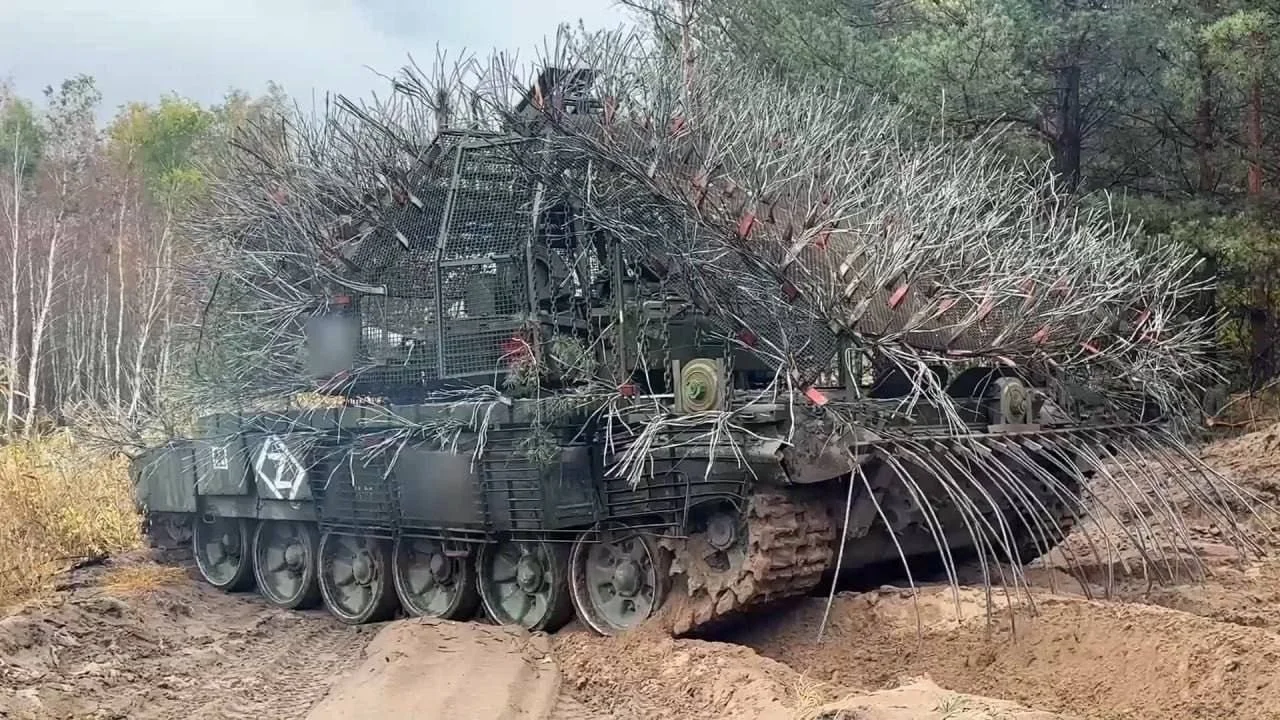
A Russian T-72B3 tank covered in improvised "Dread" armour - steel rebar arrays welded to deflect Ukrainian FPV drones. Ukraine, 2025. Reuters
The Robot Layer in Commerce
Parallel to warfare, the commercial sphere has developed its own robot layer - a dense mesh of AI systems that mediate nearly every consumer interaction. Recommendation engines, search crawlers, and generative assistants now determine what content is seen, which products surface, and how attention circulates. Industry analyses show the scale of this mediation: platforms like Netflix attribute around 80% of all views to algorithmic recommendations.
In marketing, these systems have become gatekeepers. Brands no longer communicate directly with consumers; they must first pass through AI intermediaries that personalise content based on real-time behavioural signals. Visibility increasingly depends on machine legibility - clean metadata, structured context, and algorithmic compatibility - rather than human persuasion alone. The audience you reach is the one the robots permit.
Parallels Between Warfare and Commerce
The logic underpinning the robot layer is consistent across domains: mediation amplifies scale, compresses distance, and rewards those who fuse human insight with machine efficiency. In warfare, drones create a new physics of combat, where swarms of low-cost, networked systems outpace traditional forces and reshape the battlespace. In commerce, the same dynamic plays out as algorithms compete for attention, filter discovery, and adjudicate visibility.
Both arenas involve contested mediation. On the battlefield, drones fight for ISR dominance -command of perception itself. In the marketplace, AI systems contest the informational airspace: search rankings, recommendation slots, and generative summaries. Victory depends not only on capability, but on being interpretable by the machines that now structure the field.
What is the potential impact of this new form of mediation? What happens if brands cannot find their voice in this new, denser, louder informational airspace?
Interbrand’s Best Global Brands 2025 report shows that the top 100 brands are now collectively valued at $3.6 trillion - a $150 billion increase on 2024 - despite (or perhaps because of) the turbulence created by AI. The report makes clear that “in the age of AI and ‘agentic commerce,’ visibility no longer guarantees choice” if brands fail to adapt, as consumers increasingly delegate decisions to algorithms. As Interbrand's Global Chief Strategy Officer Manfredi Ricca notes, brands must focus on “the ability... to remain top-of-mind... through its perceived indispensability,” or risk fading into irrelevance. The brands that are growing are exactly those that bend toward algorithmic mediation; the ones that don’t simply become invisible to the robot layer.
Building for Bots and Beings: Strategic Implications
To operate effectively within the robot layer, organisations must design for two audiences simultaneously: machines that mediate access, and humans who ultimately grant meaning. Interbrand’s latest analysis highlights the tension here. Some brands treat themselves as replicable wrappers - fungible assets traded by AI intermediaries - surrendering control over perception. Others attempt to defy agentic agents by shaping the very narratives that algorithms pull from, preserving distinctiveness in an increasingly machine-mediated arena.
So algorithmic visibility and human relevance now carry measurable market consequences.
According to Interbrand’s Role of Brand Index (RBI), every 1-point increase correlates with an average 2.3% rise in share price. If brands fail to appeal to both humans and machines, the market consequences will be severe.

A field in Ukraine strewn with fibre optic cables from drones. Still from video posted on telegram Channel. The image has been expanded using Adobe Firefly. No clear source could be found at the time of publishing.
So what’s a brand to do?
Here are some practical strategies:
Optimising for Machines:
Structure metadata, ontologies, taxonomies, and content for AI legibility so algorithms can reliably parse, rank, and recommend your brand.Preserving Human Resonance:
Invest in authenticity, emotional storytelling, and cultural signals that AI cannot fully originate or replicate.Securing Narrative Control:
Proactively define meaning across platforms to prevent algorithmic drift, misinterpretation, or unintentional rewriting of your brand.Building Adaptive Ecosystems:
Develop flexible, multi-channel networks that can adapt as AI intermediaries evolve, shift, or reprioritise signals.
Failure to operate in this dual mode leads to invisibility. On the battlefield, forces that cannot mediate through sensors and drones lose positional advantage. In markets, brands that fail to optimise for the robot layer simply vanish from the consumer’s algorithmic horizon.
Conclusion
The robot layer marks a structural shift in how humans perceive, act, and influence - an environment in which every interaction is filtered through machines that require simultaneous optimisation for bots and beings. As seen in both contemporary warfare and commercial analyses such as Interbrand’s 2025 report, advantage now flows to those who integrate with this layer rather than resist it. Mastery of machine mediation preserves relevance; failure invites obsolescence.
The way I would put this simply, is that due to the robot layer, scale itself is scaling and brands that cannot embrace this shift will become invisible. The task for every brand is not to fight the layer, but to understand it well enough to shape it.
References
ADF Magazine. 2025. "As Drone Warfare Expands in Africa, Turkey Increases Share of the Market." ADF Magazine, February 11. https://adf-magazine.com/2025/02/as-drone-warfare-expands-in-africa-turkey-increases-share-of-the-market/
AppleInsider. 2025. "Apple Tops Global Brands as Others Chase Shiny AI Hype." AppleInsider, October 16. https://appleinsider.com/articles/25/10/16/apple-tops-global-brands-as-others-chase-shiny-ai-hype
Atlantic Council. 2025. "Ukraine's Drone War Lesson for Europe: Technology is Nothing Without Training." Atlantic Council, November 11. https://www.atlanticcouncil.org/blogs/ukrainealert/ukraines-drone-war-lesson-for-europe-technology-is-nothing-without-training/
Big Think. 2025. "AI Agents Will Outmaneuver Salespeople by Optimizing Persuasion." Big Think, February 17. https://bigthink.com/the-future/ai-agents-will-outmaneuver-salespeople-by-optimizing-persuasion/
Bloomberg. 2025. "Ukraine Is Becoming a Major Drone Producer in the World." Bloomberg, November 12. https://www.bloomberg.com/news/articles/2025-11-12/ukraine-is-becoming-a-major-drone-producer-in-the-world
CEPA. 2025. "How Are Drones Changing War? The Future of the Battlefield." Center for European Policy Analysis, November 3. https://cepa.org/article/how-are-drones-changing-war-the-future-of-the-battlefield/
Constructor. 2025. "AI Recommendation Engines in Ecommerce." Constructor, March 6. https://constructor.io/blog/ai-recommendation-engines-in-ecommerce/
CSIS. 2025. "The Russia-Ukraine Drone War: Innovation on the Frontlines and Beyond." Center for Strategic and International Studies, May 28. https://www.csis.org/analysis/russia-ukraine-drone-war-innovation-frontlines-and-beyond
Defense News. 2023. "Kuwait to Buy Turkish-Made TB2 Drones in $367 Million Deal." Defense News, June 14. https://www.defensenews.com/global/mideast-africa/2023/06/14/kuwait-to-buy-turkish-made-tb2-drones-in-367-million-deal/
Gartner. 2023. "How to Capitalize on Generative AI to Improve Content Marketing." Gartner. https://www.gartner.com/en/newsroom/press-releases/2023-07-25-gartner-says-generative-ai-will-have-significant-impact-on-enterprise-marketing-in-next-five-years
Interbrand. 2024. "Best Global Brands 2024 Report." Interbrand. https://interbrand.com/best-global-brands/2024/
Interbrand. 2025. "Best Global Brands 2025." Interbrand. https://interbrand.com/best-global-brands/
Lovink, Geert. 2019. Sad by Design. London: Pluto. https://www.plutobooks.com/9780745339993/sad-by-design/
McKinsey. 2025. "New Front Door to the Internet: Winning in the Age of AI Search." McKinsey & Company, October 16. https://www.mckinsey.com/capabilities/growth-marketing-and-sales/our-insights/new-front-door-to-the-internet-winning-in-the-age-of-ai-search
MediaPost. 2025. "Agents As Brand Influencers Collapse Consumer Buying Journey." MediaPost, October 17. https://www.mediapost.com/publications/article/401203/agents-as-brand-influencers-collapse-consumer-buyi.html
Oyelabs. 2025. "Building AI-Powered Recommendation System: A Complete Guide." Oyelabs, September 13. https://www.oyelabs.co/building-ai-powered-recommendation-system/
Precedence Research. 2025. "Recommendation Engine Market Size and Forecast 2025 to 2034." Precedence Research, August 28. https://www.precedenceresearch.com/recommendation-engine-market
PRNewswire. 2025. "Brands Adapting to Market Challenges Increases the Total Value of Interbrand's 2025 Best Global Brands by $150 Billion." PRNewswire, October 15. https://www.prnewswire.com/news-releases/brands-adapting-to-market-challenges-increases-the-total-value-of-interbrands-2025-best-global-brands-by-150-billion-302294567.html
Spyro-Soft. 2025. "Why Are Content Recommendation Engines Essential for OTT Success?" Spyro-Soft, September 19. https://spyro-soft.com/blog/ott/why-are-content-recommendation-engines-essential-for-ott-success
SuperAGI. 2025. "2025 Trends in AI Recommendation Engines: How AI is Revolutionizing Product Discovery Across Industries." SuperAGI, June 30. https://superagi.com/2025-trends-in-ai-recommendation-engines-how-ai-is-revolutionizing-product-discovery-across-industries/
U.S. Air Force. 2025. "MQ-9 Reaper Fact Sheet." U.S. Air Force. https://www.af.mil/About-Us/Fact-Sheets/Display/Article/104548/mq-9-reaper/
Wark, McKenzie. 2019. Capital Is Dead. London: Verso. https://www.versobooks.com/books/3045-capital-is-dead