Deranged Visual Culture
In this article I dive into a concept I’ve been thinking about lately.
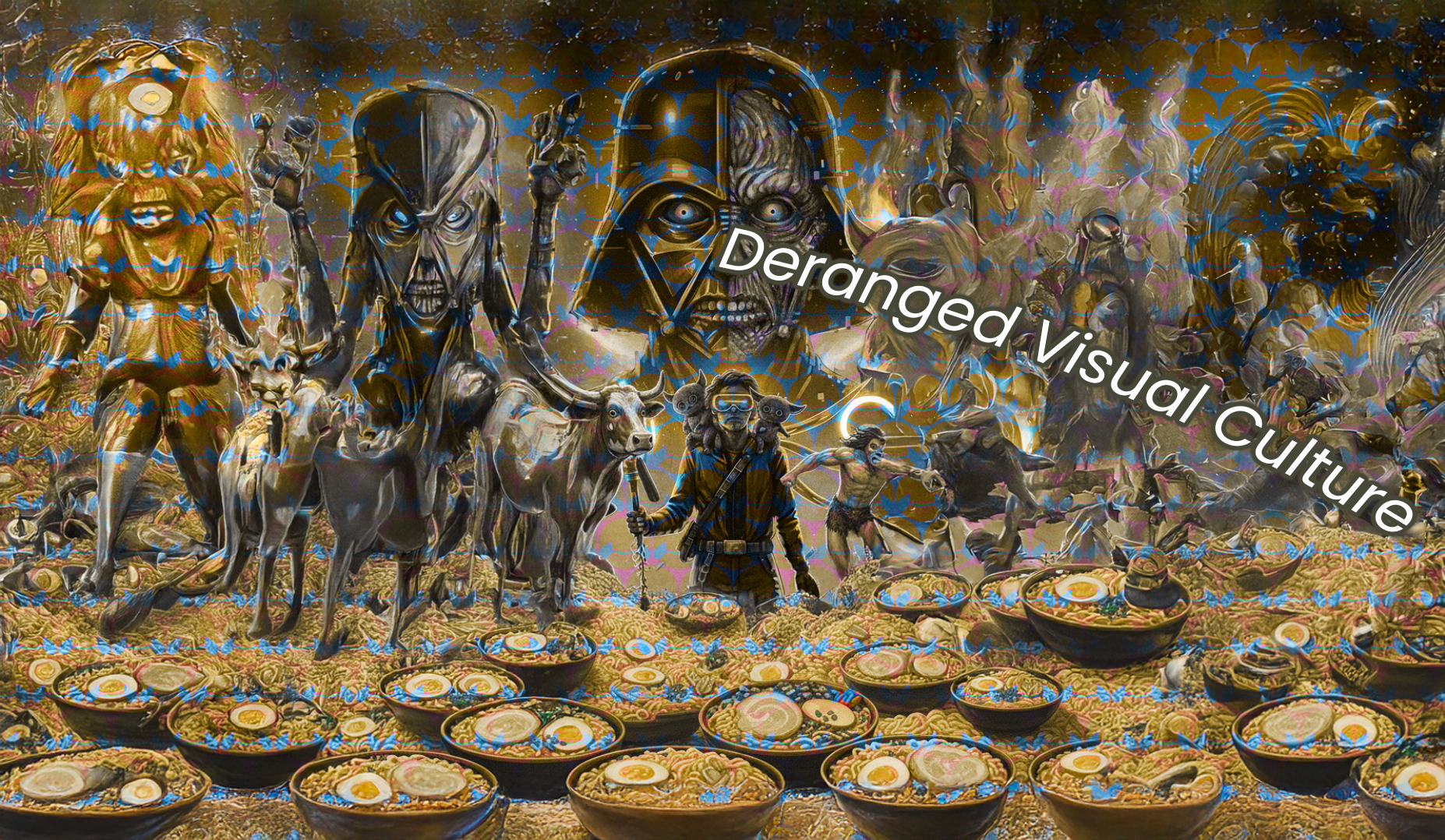
Who knows what lies beyond the loosely defined parameters of the human imagination?
As AI-generated doomscroll content irreversibly self-duplicates (Zuboff 2019; Bridle 2022) and blockchain aesthetics go mainstream (Bratton 2023; Herian 2024), welcome to the era of Deranged Visual Culture.
As AI-generated doomscroll content escalates and blockchain culture goes mainstream, we have entered the era of Demented Visual Culture - a condition where the act of seeing has become inseparable from the act of generating (Manovich 2020). The image is no longer a representation of reality but an autonomous organism, mutating, feeding, and self-replicating across networks (Parikka 2016; Steyerl 2017). What once described the logic of brands - perpetual self-production, self-reference, self-valorisation (Lury 2004; Arvidsson 2006) - has now metastasised into the visual field itself. Images produce their own demand, their own consumption, their own meaning (Dean 2010). We scroll not to witness the world, but to confirm that it still flickers (Chun 2016).
Jean Baudrillard foresaw this in Simulacra and Simulation: the map would consume the territory, and the copy would precede the original (Baudrillard 1981, 1). But today, the simulacrum has gone synthetic. Hito Steyerl’s “poor image” - compressed, degraded, and endlessly circulated - has become the planetary default (Steyerl 2009). The low-res doomscroll is our lingua franca (Lovink 2019). Meaning dissolves under the weight of virality, just as resolution decays under the weight of circulation (Sampson 2012). The result is what might be called aesthetic derangement: the breakdown of narrative coherence under conditions of infinite remix (Bourriaud 2002; Goriunova 2012). We live not in the age of the image but in the age of its afterimage - a hallucination that forgets it is dreaming (Fisher 2014).

Uncontrollable image creation:
Loab (pronounced lōb) is an internet-born myth and phenomenon from 2022 - essentially an accidental digital ghost that emerged from AI image generation systems.
The material of this culture is everywhere. Fake war footage generated by AI circulates as genuine atrocity (Chesney and Citron 2019; Paris and Donovan 2023); the Loab phantom haunts latent space like the first myth of the algorithmic unconscious (Supercomposite 2022); TikTok’s “NPC livestreamers” rehearse automation as theatre (Abidin 2021); AI influencers model the perfection of desire without ever existing (Miquela 2016–). Even memes - Skibidi Toilet, Ohio edits, AI yearbook portraits - form a new folk art of delirium, born from the frictionless loops of recommendation engines (Shifman 2014; Phillips and Milner 2017). These artefacts aren’t exceptions to culture; they are culture. They reveal a media ecosystem whose primary product is entropy - a system that sells the spectacle of its own collapse (Dean 2009).
This is not simply a crisis of content but of cognition. As Mark Fisher wrote in Capitalist Realism, it is easier to imagine the end of the world than the end of the feed (Fisher 2009, 2). Franco Berardi’s “semiotic saturation” describes the psychic fatigue of processing too much meaning for too long (Berardi 2012). McKenzie Wark extends this into the domain of data: value now resides not in creation but in capture, in the extraction of attention from the endless churn (Wark 2019). The blockchain adds a theological twist - promising authenticity and ownership precisely where reality has become unverifiable (Golumbia 2016; DuPont 2019). In DVC, every pixel is a commodity, every scroll an act of faith (Brunton 2023).
Yet beneath the grotesque spectacle there is a strange beauty - a post-human Baroque, exuberant, excessive, self-devouring (Zamora 2016). In the same way Have I talked to you about Pre-Dreadnought Battleships? describes obsolescence as a structural condition of innovation, DVC treats collapse as the aesthetic baseline of the digital age. It is culture after coherence: radiant, recursive, demented. To create within it is to accept that the image no longer belongs to us - that it now dreams, deteriorates, and desires on its own (Weizman 2022).
References
Abidin, Crystal. 2021. “From NPC Streaming to Live Commerce.” New Media & Society 23 (6): 1567–85.
Arvidsson, Adam. 2006. Brands: Meaning and Value in Media Culture. London: Routledge.
Baudrillard, Jean. 1981. Simulacra and Simulation. Translated by Sheila Faria Glaser. Ann Arbor: University of Michigan Press.
Berardi, Franco. 2012. The Uprising: On Poetry and Finance. Los Angeles: Semiotext(e).
Bourriaud, Nicolas. 2002. Postproduction. New York: Lukas & Sternberg.
Bratton, Benjamin H. 2023. The Stack on Blockchain. Cambridge, MA: MIT Press.
Bridle, James. 2022. Ways of Being. London: Allen Lane.
Brunton, Finn. 2023. Digital Cash. Princeton: Princeton UP.
Chesney, Robert, and Danielle Citron. 2019. “Deep Fakes: A Looming Challenge.” California Law Review 107: 1753–1819.
Chun, Wendy Hui Kyong. 2016. Updating to Remain the Same. Cambridge, MA: MIT Press.
Dean, Jodi. 2009. Democracy and Other Neoliberal Fantasies. Durham: Duke UP.
Dean, Jodi. 2010. Blog Theory. Cambridge: Polity.
DuPont, Quinn. 2019. Cryptocurrencies and Blockchains. Cambridge: Polity.
Fisher, Mark. 2009. Capitalist Realism. Winchester: Zero Books.
Fisher, Mark. 2014. Ghosts of My Life. Winchester: Zero Books.
Golumbia, David. 2016. The Politics of Bitcoin. Minneapolis: University of Minnesota Press.
Goriunova, Olga. 2012. “The Force of Digital Aesthetics.” Computational Culture 2.
Herian, Rob. 2024. Blockchain and the Law. London: Routledge.
Lovink, Geert. 2019. Sad by Design. London: Pluto.
Lury, Celia. 2004. Brands: The Logos of the Global Economy. London: Routledge.
Manovich, Lev. 2020. AI Aesthetics. Moscow: Strelka Press. Miquela (@lilmiquela). 2016–. Instagram profile, ongoing.
Parikka, Jussi. 2016. Digital Contagions. 2nd ed. New York: Peter Lang.
Paris, Britt, and Joan Donovan. 2023. “Deepfake War Footage.” First Monday 28 (4).
Phillips, Whitney, and Ryan M. Milner. 2017. The Ambivalent Internet. Cambridge: Polity.
Sampson, Tony D. 2012. Virality. Minneapolis: University of Minnesota Press.
Shifman, Limor. 2014. Memes in Digital Culture. Cambridge, MA: MIT Press.
Steele, Joseph. 2024. “Have I ever talked to you about Pre-Dreadnought Battleships?” josephsteele.de/blog.
Steyerl, Hito. 2009. “In Defense of the Poor Image.” e-flux 10.
Steyerl, Hito. 2017. Duty Free Art. London: Verso.
Supercomposite (@supercomposite). 2022. “Loab” thread. Twitter, 5 Sep.
Wark, McKenzie. 2019. Capital Is Dead. London: Verso.
Weizman, Eyal. 2022. “Forensic Aesthetics.” e-flux 118.
Zamora, Daniel. 2016. The Baroque as Excess. London: Bloomsbury.
Zuboff, Shoshana. 2019. The Age of Surveillance Capitalism. New York: PublicAffairs.